STELVIO PASS, ITALY — THE WORLD’S MOST FAMOUS DRIVING ROAD
Since 1898, when it hosted one of the earliest motor hill-climbs, the Passo dello Stelvio has thrilled drivers with dizzying hairpins and dramatic high-alpine views. Made world-famous by Top Gear (2008), Stelvio is often hailed as one of the greatest driving roads in the world.
Everything planned and booked?
👉 Stelvio & Alps 10 Passes Driving Tour
👉 5-Country Grand Tour of the Alps
Before you drive it, here’s your complete Stelvio guide — from where it sits to why it lives in every driving enthusiast’s imagination.
Stelvio Pass Live Webcam 📹
Check the current weather, visibility and conditions at the Stelvio Pass before your drive.
Live webcam provided by an external website.

Scenic: ★★★★☆
Thrilling: ★★★★★
THE FAME OF THE STELVIO PASS
Stelvio’s leap from “insider’s Alpine pass” to global driving icon can be traced to 2008, when the hugely popular British motoring show Top Gear put it on the international map. In the episode “In Search of Driving Heaven,” the presenters — Jeremy Clarkson, Richard Hammond, and James May — crossed Europe in three supercars:
Lamborghini Gallardo Superleggera
Porsche 911 GT3 RS
Aston Martin V8 Vantage N24
After sampling a string of great roads and mountain passes — from France’s Col de Turini to scenic stretches in Switzerland’s Engadine Valley — they crossed into Italy and climbed the Stelvio. That’s when things escalated.
Clarkson’s now-famous verdict — calling Stelvio “the greatest driving road in the world” — turned a spectacular but relatively niche pass into a must-do destination almost overnight. Since then, it has become one of the most talked-about roads on the planet, landing on the bucket lists of millions. And every summer, they come: motorists from all corners of the world, on motorbikes, bicycles, supercars — and yes, we’ve even seen skateboards.

THE LOCATION OF THE STELVIO PASS
The Stelvio Pass sits in the Ortler Alps in northern Italy, just south of Switzerland’s Engadine Valley. On the map, it’s signed as SS38, climbing above Bormio and skirting the border of South Tyrol (Province of Bolzano).
The wider Stelvio region is also famous as a year-round ski area, with summer skiing typically running from May to October. From the pass, a cable car links up to the ski slopes of Livrio.
But for most visitors, the main attraction is the drive: a relentless sequence of tight hairpins and dramatic elevation changes on the Bormio–Trafoi route. Stelvio connects Prato allo Stelvio (South Tyrol, northeast of the pass) with Bormio (Sondrio, southwest of the pass) — and it’s only a stone’s throw from Switzerland.
WHAT TO EXPECT FROM THE STELVIO
At 2,757 metres (9,045 ft) above sea level, the Stelvio Pass is the highest paved mountain road in the Eastern Alps and the second-highest in the entire Alpine range — just 7 metres (23 ft) lower than France’s Col de l’Iseran.
Stelvio is legendary for its switchbacks. The northern ascent — the famous “North Face” — features 48 numbered hairpins, forming a near-vertical wall of asphalt that has become one of the most recognisable road images in the world.
The classic Trafoi–Bormio crossing measures roughly 35 kilometres (21 miles). Add the approach to Trafoi — another 20–25 km (12–15 miles) of engaging mountain road — and it becomes clear why many drivers count Stelvio as a full-day driving experience, not just a single pass.
THE UGLY TRUTH ABOUT STELVIO — AND WHY IT STILL MATTERS
Here’s the honest part: the entire 47 kilometres (29 miles) of the Stelvio Pass isn’t conventionally “beautiful” in the postcard sense. This isn’t a lush Alpine meadow road from start to finish.
Instead, the drama lies elsewhere.
You begin in dense woodland, before the scenery opens up into a stark, almost surreal high-alpine environment dominated by rock faces, scree, and sheer exposure. Vegetation becomes sparse — just patches of grass and low shrubs clinging to the mountainside. And yet, visually, Stelvio is one of the most dramatic passes in the Alps — not because of softness or colour, but because of its brutal geometry.
WHY STELVIO IS CALLED THE QUEEN OF PASS ROADS
Stelvio is often referred to as the “Queen of Alpine Pass Roads” — a title earned through pure engineering ambition. At nearly 2,800 metres (9,200 ft), it ranks among the highest drivable roads in the world, and few places anywhere can match its density of switchbacks.
Are there 48 hairpins? Some sources say 46, others 48.
Frankly, once you’re driving it, counting becomes irrelevant.
The relentless sequence of tight, steep, 90-degree bends demands full concentration. Many hairpins must be taken at 30 km/h (18 mph) or less to avoid bottoming out, drifting wide, or cutting into oncoming traffic — which faces exactly the same challenge from the opposite direction.
This is not a road for distraction.And that’s precisely why it’s unforgettable.
We didn’t count the corners. We were far too busy having fun.
HISTORY OF THE STELVIO PASS
The corridor between Alta Valtellina and the Vinschgau (Val Venosta) has been used since Bronze Age times — long before the Stelvio became a headline-grabbing driving road.
In the early 19th century, the Austrian Empire pushed for a reliable route linking Vienna and Milan and strengthening access between Lombardy and the Tyrol. The result was the Passo dello Stelvio, engineered by Carlo Donegani. His road was a masterpiece of its time, finally connecting Lombardy (then part of the Austrian sphere; today Italy) with the rest of the empire across the high Alps.
For decades, the pass was used year-round — but since the early 20th century it has typically been closed in winter, as snowfall and avalanche risk make regular maintenance impractical at these elevations.
Stelvio’s motorsport story began early, too. In 1898, it hosted its first hill-climb event for motor vehicles — machines whose top speeds were still below 20 mph (32 km/h).
Then history turned darker. During World War I, the surrounding peaks became a frontline between the Austro-Hungarian Empire and the Kingdom of Italy, with artillery positions facing each other across the mountains. Even the neutral Swiss — who maintained an outpost above the pass — reportedly complained about stray fire, prompting both sides to adjust where they aimed to avoid endangering Switzerland.
After the war, competition returned — on two wheels and four. Cyclists, in particular, helped cement Stelvio’s myth, most famously through the Giro d’Italia, where the pass has featured repeatedly since the 1950s and remains one of the race’s most iconic high-mountain stages.
Today, Stelvio is where high-alpine drama meets the promise of the south — a road that blends the raw intensity of the north-side climb with the sense of Italian Mediterranean flair waiting beyond the summit.

IS THE STELVIO PASS OPEN?
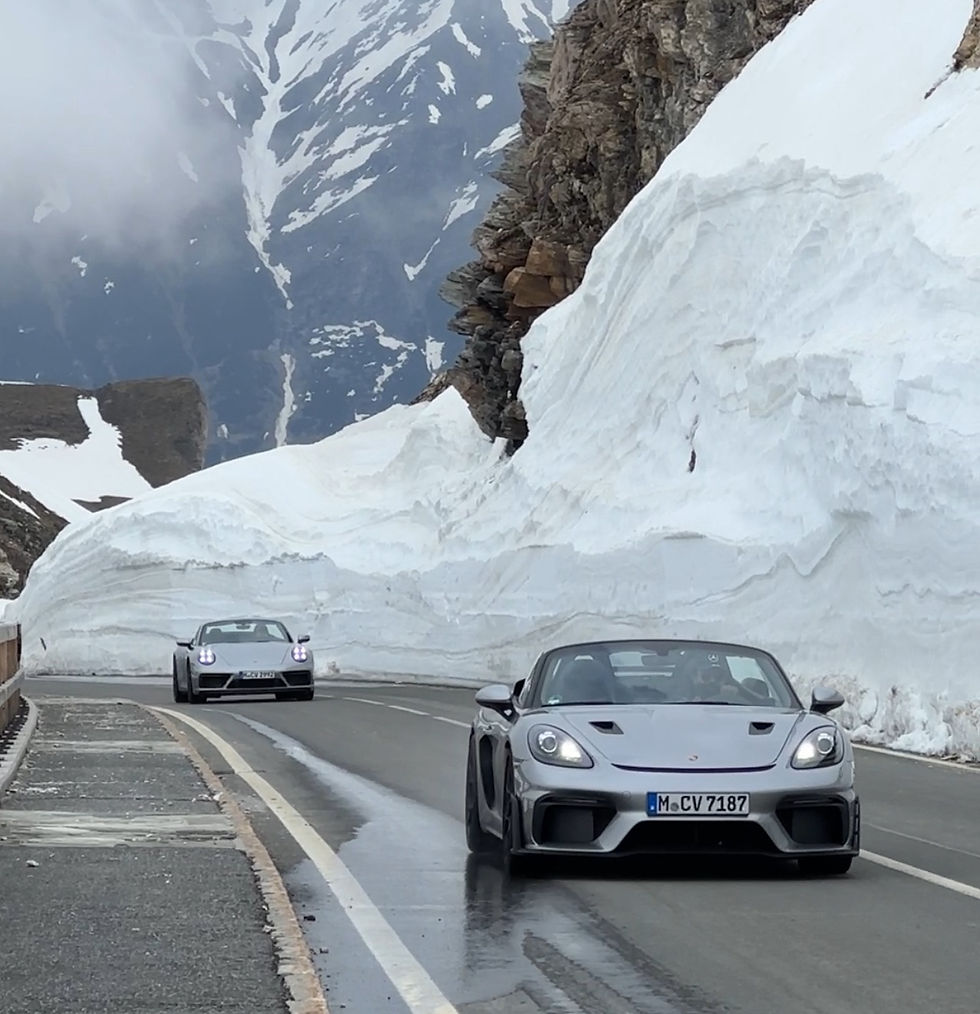
The Stilfser Joch — as the Stelvio Pass is known in German — also sits beside one of the Alps’ rare summer-ski areas. Even in peak summer, it’s common to find patches of snow near the summit, especially after a cold night or a late snowfall.
Under normal conditions, the road is kept clear and typically opens between mid and late May, then stays accessible until the end of October. Like most high-alpine passes, Stelvio closes for winter due to snowfall and avalanche risk — and there’s no fixed official closing date, as the timing ultimately depends on weather and road conditions.
👉 Check current Stelvio Pass road status on the official Bormio website
👉 Planning to drive it? Have a look at our Stelvio & Swiss Alps 10 Passes supercar tour
FOLLOW THIS ADVICE FOR THE STELVIO PASS DRIVING EXPERIENCE
FIRST — RESPECT THE STELVIO
The Stelvio can turn into your enemy if you rush it. Take your time and build rhythm — the road is tight, steep, and relentlessly technical. Its hairpins are among the most demanding in the world, and we strongly recommend Stelvio only for experienced, confident drivers.
If you’ve never driven in the Alps before, Stelvio can be surprisingly exhausting — especially if your first attempt is in a supercar, where visibility, width, power delivery, and braking all add pressure.
For the full, iconic experience, approach from the north-west (Trafoi side). This is the famous wall of switchbacks — the “North Face” — and it’s also where you’ll get the most legendary photo opportunities.
SECOND — DRIVE THE RIGHT CAR
Stelvio is not the place for oversized vehicles. We’ve seen motorhomes attempt the climb, realise halfway up that it’s a terrible idea, and then try to turn around — blocking the road and creating a full-blown traffic jam on the pass. Nobody was happy.
Choose a car that’s narrow enough, well-braked, and easy to place on the road — and make sure you’re comfortable with tight, low-speed manoeuvring before you commit.
THIRD — BEAT THE TRAFFIC
Traffic can be the Stelvio’s biggest frustration — especially if you’re in a fast car and can’t get into a flow. The pass is famous, which means it’s rarely empty.
That’s why timing matters. Start early, ideally before breakfast traffic builds, and avoid weekends and public holidays if you want a cleaner run. Do that, and you’ll get much closer to the “Top Gear” style experience — because let’s be honest: they almost certainly had roads controlled for filming.
On Stelvio, you’re sharing the road with cyclists, motorbikes, cars, and camper vans — all competing for the same ribbon of asphalt. The early start is the difference between a stop-start crawl and a proper mountain drive.
And if you’re a purist? Catching the sunrise up there is unforgettable
OUR VERDICT ABOUT THE STELVIO PASS
The vast majority of international visitors come to the Stelvio for one reason: Top Gear (2008). The episode turned an Italian mountain pass into a modern driving legend — and if we’re honest, it’s probably why you’re reading this today.
Unsurprisingly, Stelvio also scores highly on Tripadvisor. People fly in from all over the world for this one road, and for many, it’s their first time driving above 2,000 metres (6,562 ft). That altitude alone almost guarantees a sense of excitement and awe.
But here’s what most visitors don’t realise:
A big part of what Top Gear celebrated isn’t actually the Stelvio Pass itself — it’s the Fuorn Pass (Ofenpass) in Switzerland’s Engadine. That road connects the region toward the Swiss border and, from a pure driving perspective, it’s often the more enjoyable experience.
Yes, Stelvio’s 48 numbered hairpins are iconic on paper — and even more iconic in photos. But hairpins aren’t always “fun” in the way people imagine, especially in a modern supercar. Many drivers prefer sweeping, flowing corners that allow you to build rhythm, feel the chassis, and drive with confidence — instead of repeating first-gear turns at 30 km/h (18 mph) while watching for oncoming traffic.
So our verdict might surprise you:
Not because it isn’t spectacular — it is — but because Switzerland next door often does it better: less traffic, better surfaces, wider lanes, and more scenery-per-kilometre. Stelvio is dramatic and technical, but it’s also demanding, and we recommend it primarily for experienced drivers and true enthusiasts.
The good news is that only a short drive away, you can enjoy roads with cleaner flow, lighter traffic, and higher driving pleasure — while still keeping Stelvio as the headline moment.
And one last word on Top Gear: almost any road feels perfect if you can control traffic for filming.
Still, when the planning is done right — and Stelvio is combined with the best roads around it — the ultra-high summit at 2,757 m (9,045 ft) becomes exactly what it should be: a memorable, bucket-list adventure.
Just as Jeremy Clarkson put it: “The Stelvio Pass is the cherry on top of a cake.”