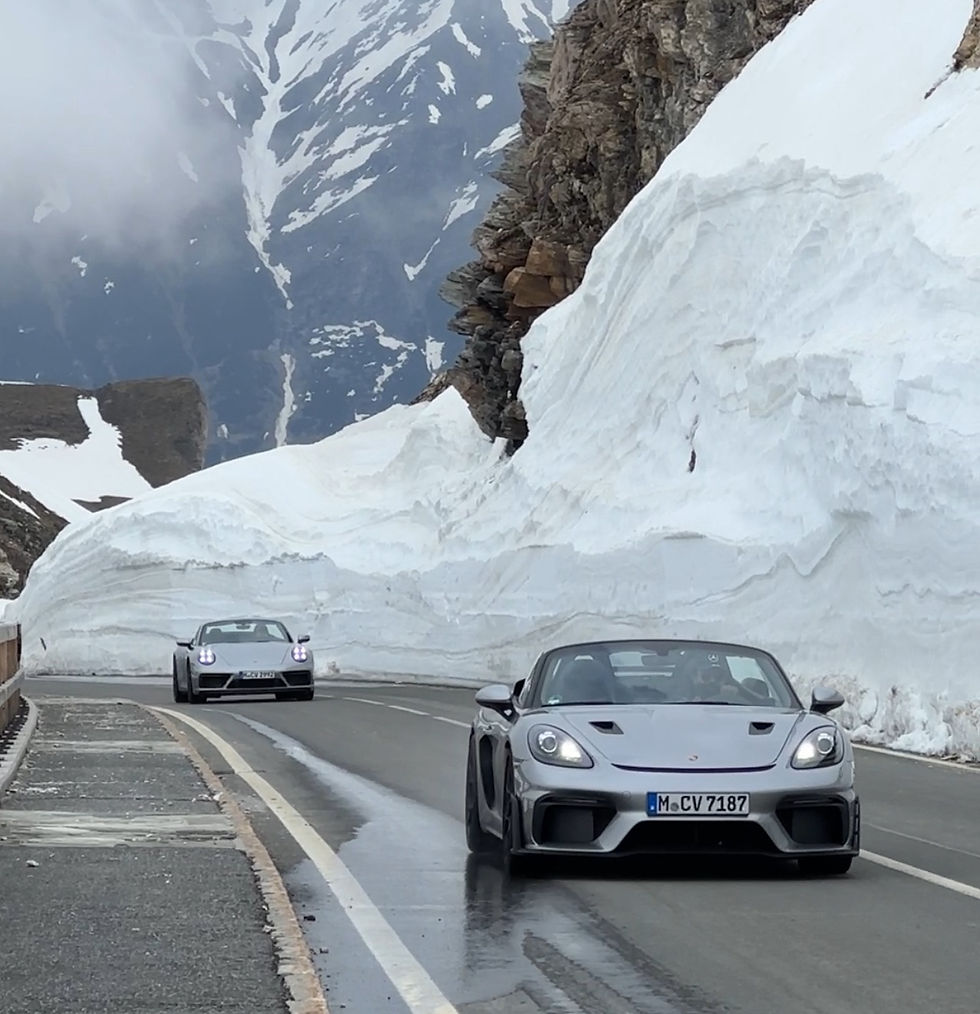
OBERALP PASS SWITZERLAND – EPIC ALPINE ROAD TO ANDERMATT
The Oberalp Pass 🇨🇭 is one of Switzerland’s most scenic high-alpine roads — a flowing mountain drive rising to 2,044 m (6,706 ft) between Andermatt and Disentis/Mustér.
Unlike the more technical hairpin passes nearby, Oberalp is all about smooth rhythm: wide curves, open sightlines and expansive mountain scenery above 2,000 meters. It also shares the stage with the world-famous Glacier Express, making this one of the rare Swiss passes where road and rail cross the same high-alpine landscape.

Scenic: ★★★★★
Thrilling: ★★★☆☆
WHAT DRIVING THE OBERALP PASS FEELS LIKE
Oberalp is often described as “easy” — but in a good way.
Wide carriageway by alpine standards
Clean sightlines and predictable corners
Long sweepers and gentle elevation changes
Generally excellent road surface
It’s a road that rewards smooth steering and tidy lines more than aggression. That makes it ideal for relaxed, confident driving — especially if you’re pairing it with more technical passes on the same day.

SCENERY AND HIGHLIGHTS
Beyond the summit itself, the eastern descent toward Graubünden opens access to several cultural and natural highlights.
Disentis Abbey (Kloster Disentis) — one of the oldest Benedictine monasteries in Switzerland, located in the village of Disentis.
Ruinaulta ("Swiss Grand Canyon") — a dramatic Rhine gorge carved through white limestone cliffs, offering striking viewpoints and short detours for scenic stops.
These additions make Oberalp more than just a mountain crossing — it becomes part of a broader alpine landscape shaped by history and geology.
The scenery changes subtly as you climb:
Alpine meadows and open valleys near Andermatt
Higher plateaus with broad, panoramic views
A gradual shift from central Switzerland into the culturally distinct east
THE LIGHTHOUSE AT 2,044 M (6,706 FT) (AND WHY IT EXISTS)
At the summit you’ll find the Oberalpsee (Oberalp Lake) and, unexpectedly, a red lighthouse.
The lighthouse is symbolic. The Oberalp region lies near the source of the River Rhine, which begins its journey in these mountains and flows approximately 1,230 kilometres (764 miles) north through Switzerland and Germany before reaching the North Sea.
At the opposite end of that journey — where the Rhine meets the sea — real lighthouses guide ships into port. The Oberalp lighthouse creates a poetic connection between the river’s alpine origin and its maritime destination.
In simple terms: the Rhine begins in the mountains and ends at the sea.The lighthouse marks the start of that long journey.
It’s also one of the easiest “summit moments” to enjoy in Switzerland: pull in, step out for a few minutes, and you have a striking photo spot at the literal beginning of one of Europe’s great rivers.
GLACIER EXPRESS: WHERE ROAD AND RAIL SHARE THE PASS
One of Oberalp’s most distinctive features is its close relationship with the Glacier Express railway line. At 2,044 m (6,706 ft), the Oberalp Pass is the highest point of the entire Glacier Express journey between Zermatt and St. Moritz. As the train climbs to this summit, it crosses the same open high-alpine plateau that drivers experience on the road.
In several sections, the road runs parallel to the tracks operated by the Matterhorn Gotthard Bahn. It’s not unusual to see the panoramic train winding through the landscape beside you — road and rail sharing the very highest part of the transalpine crossing.
This pairing adds a uniquely Swiss dimension to the experience:
Precision engineering in both road and railway
Historic alpine infrastructure
A shared summit at the literal high point of the train’s route
Oberalp is not just a mountain pass — it is the elevated climax of one of the world’s most famous train journeys.
ANDERMATT: THE PERFECT BASE FOR A MULTI-PASS DAY
Oberalp’s western side drops you straight into Andermatt, which is arguably the best-located hub for alpine driving in Switzerland. From here, you’re connected to a full menu of world-class passes — making it easy to build a day that suits your driving mood.
The “Big Three” nearby
Furka Pass — iconic, technical, cinematic
Grimsel Pass — wide, dramatic, photogenic
Susten Pass — beautifully engineered, fast-flowing, and scenic
More options if you want to extend
Lukmanier Pass — quieter, more remote, a great continuation east
Klausen Pass — classic Swiss mountain drive with big views and strong character
This is the real strength of Oberalp: it’s not only a satisfying pass on its own, it also slots perfectly into an Andermatt-based pass circuit — either as a smoother counterbalance to hairpins, or as the connector that takes you onward toward Graubünden and the Engadin.
One of Oberalp’s most distinctive features is that parts of the route run alongside the tracks used by the Glacier Express and regional Matterhorn Gotthard Bahn trains. It's not unusual to see the panoramic train moving through the landscape at altitude, creating a rare “road and rail” moment in the Alps — a small detail that makes the pass feel unmistakably Swiss.
A BRIEF HISTORY OF OBERALP PASS
Long before it became a favorite route for drivers and train travelers, the Oberalp Pass served as a practical alpine crossing between central Switzerland and the Grisons. For centuries, it was used by traders, farmers, and travelers moving goods, livestock, and ideas between valleys — a quieter but vital counterpart to more dramatic transalpine routes.
The pass gained greater strategic importance in the 19th and early 20th century with the development of modern alpine infrastructure. The construction of the Furka–Oberalp railway (today part of the Matterhorn Gotthard Bahn network) transformed Oberalp into a year-round symbolic link between regions, even though road access remains seasonal.
The lighthouse at the summit, added later, reinforces this sense of connection and origin — marking the Rhine’s source area and turning the pass into a place of reflection, not just transit. Unlike some passes shaped by military needs or international freight corridors, Oberalp evolved as a regional connector — engineered carefully into the landscape rather than forced through it. That heritage is still felt today in the road’s gentle geometry, balanced gradients, and harmonious integration with the surrounding terrain.
BEST TIME TO DRIVE OBERALP PASS
Typical season: Mid-May to mid-October (weather dependent)
Best months: June to September
Best time of day: Early morning or late afternoon for quieter traffic and better light
Because it sits just over 2,000 meters, Oberalp is a true high pass, but it’s often more forgiving than higher or narrower routes — especially when you want a scenic day without constant hairpin concentration.
TIPS FOR A BETTER OBERALP DRIVE
Fuel up in Andermatt if you’re doing multiple passes (services thin out at altitude)
Watch for bikes and motorbikes on summer weekends
Give yourself time for a summit stop — the lake and lighthouse are worth it
In shoulder season, expect rapid weather changes (sun → fog → rain can happen fast)
WHY OBERALP IS WORTH IT
Oberalp Pass isn’t about bragging rights. It’s about flow, clarity, and quiet alpine scale — a pass you’ll remember for how effortlessly it lets you move through the landscape. If you want a Swiss mountain road that feels scenic and elevated without being punishing or stressful, Oberalp is one of the best choices in the region.