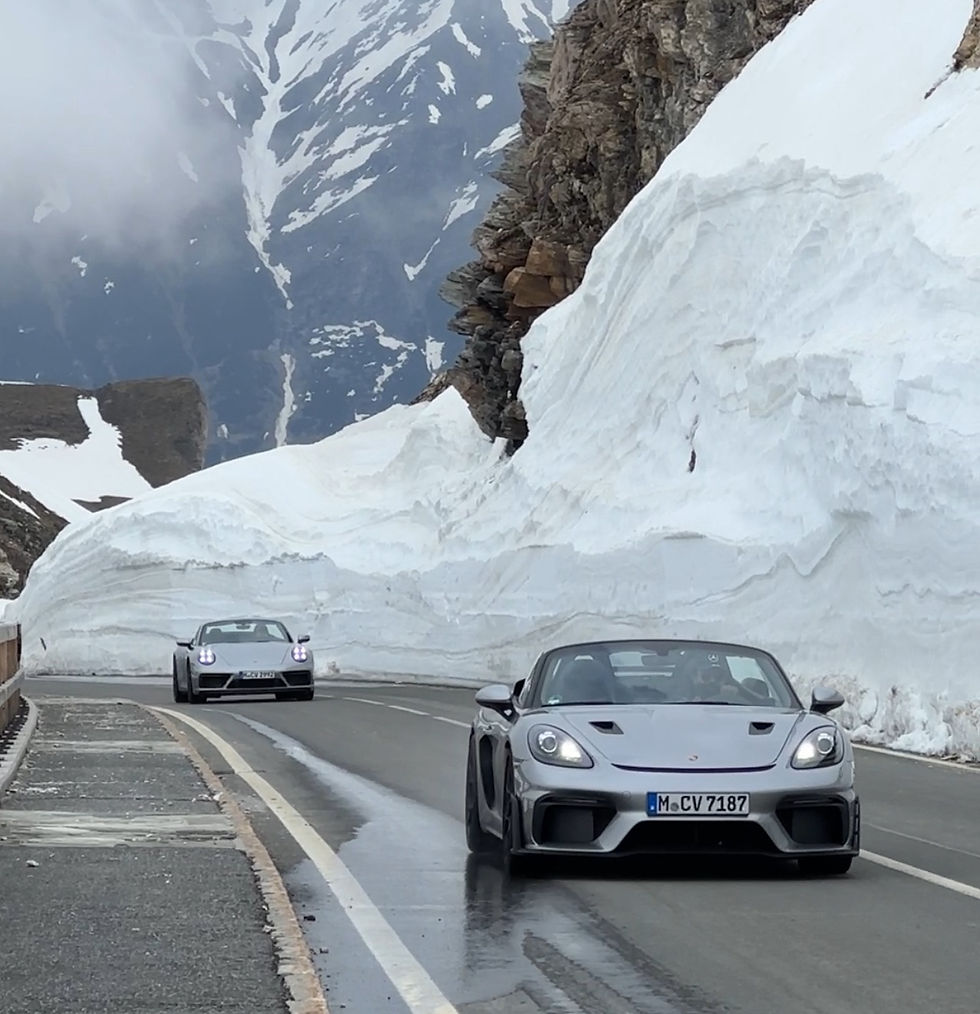
BERNINA PASS SWITZERLAND – EPIC ALPINE ROAD TO ITALY
The Bernina Pass 🇨🇭 is one of Europe’s great high-alpine drives — a spectacular mountain road climbing to 2,328 m (7,638 ft) between St. Moritz and Tirano, Italy.
This is where Switzerland turns dramatic: glacier views, turquoise summit lakes, sweeping curves and a wide-open plateau shared with the world-famous Bernina Express railway.
From the top, the descent into Val Poschiavo feels almost cinematic — from snow-covered peaks and alpine lakes toward Italian valleys, vineyards and a softer Mediterranean atmosphere.
Few roads combine scenery, scale and destination quite like the Bernina Pass.

Scenic: ★★★★★
Thrilling: ★★★★☆
DRIVING THE BERNINA PASS
From Pontresina / St. Moritz, the road rises gradually toward the summit plateau.
Bernina is less about tight hairpins and more about scale and openness:
Long, flowing curves
Wide carriageway
Clear sightlines
Expansive high-mountain scenery
At the summit, you pass Lago Bianco, a striking alpine lake marking a watershed divide between northern and southern Europe. Above the road towers the Piz Bernina massif, including Piz Bernina (4,049 m / 13,284 ft) — the highest peak in the Eastern Alps — with glaciers descending dramatically toward the valley. Descending toward Val Poschiavo, the atmosphere softens. Within roughly 35 km (22 miles), the environment transitions from glacier terrain to vineyards and Mediterranean influences near Tirano. It is one of the most elegant Switzerland-to-Italy transitions you can drive.


ST. MORITZ – THE PERFECT BASE
The Bernina Pass benefits from one of the most elegant alpine settings imaginable.
Just minutes from the climb lies St. Moritz, long regarded as one of the world’s most prestigious mountain resorts. From lakeside grand hotels and refined restaurants, you can reach the summit road in under half an hour. This proximity allows for a rare balance:
High-alpine driving
Glacier views
UNESCO heritage
Luxury hospitality
Few mountain passes are so closely connected to comfort and sophistication.
THE BERNINA EXPRESS – THE HIGHEST POINT OF THE JOURNEY
The Bernina Pass is inseparable from the Bernina Express, one of the world’s most scenic railway journeys. At Ospizio Bernina (2,253 m / 7,392 ft), the railway reaches the highest point of the entire Bernina Express route between St. Moritz and Tirano.
Unlike many Alpine railway lines, the Bernina Railway crosses the mountains without a summit tunnel. Instead, it curves openly across viaducts, high plateaus, and exposed mountain landscapes — often directly alongside the road. Watching the red panoramic train traverse the same high-alpine terrain while you drive creates a distinctly Swiss moment: precision engineering set against vast natural scale.
The Albula/Bernina railway line was inscribed as a UNESCO World Heritage Site in 2008, recognizing its exceptional engineering and cultural value.

DIAVOLEZZA – GLACIER VIEWS ABOVE THE PASS
Just off the Bernina road lies one of the most spectacular vantage points in the Swiss Alps: the Diavolezza cable car. Within minutes, the aerial tramway rises to 2,978 m (9,770 ft), placing you directly above the glacier fields of the Bernina massif. From the summit terrace, you face:
The Morteratsch Glacier
The dramatic ice formations of Piz Palü
The high peaks of the Bernina range
This effortless access to nearly 3,000 meters makes Diavolezza a natural extension of the Bernina drive — refined, dramatic, and unforgettable.
HISTORY OF THE BERNINA PASS
The Bernina route has connected the Engadin with Italy for centuries. Modern infrastructure accelerated in the late 19th and early 20th century, culminating in the completion of the Bernina Railway in 1910 — a remarkable achievement built without a summit tunnel. Its engineering elegance and scenic integration led to UNESCO World Heritage recognition in 2008. Today, Bernina remains one of the few high Alpine crossings that typically stays open year-round, reinforcing its strategic importance.
ACCESS & SEASONALITY
Distance from Zurich: approximately 200 km (124 miles)Driving time: around 2.5–3 hours, depending on conditions. Summer offers:
Clear glacier views
Brilliant lake colors
Crisp high-mountain air
Winter offers:
Snow walls
Dramatic alpine atmosphere
One of Switzerland’s most reliable high-elevation crossings
WHY BERNINA IS WORTH IT
Bernina is not primarily about technical intensity. It is about:
Glacier proximity
UNESCO rail heritage
A refined base in St. Moritz
A seamless transition from Switzerland into Italy
Year-round accessibility
If you want an Alpine crossing that feels both iconic and effortless — where engineering, geography, and elegance meet — Bernina delivers.